
- Recommended Tours
- About Company
- Destination
- Tour Packages
- Holiday Type
- Adventure
- Ayurmeds Buddhist
- Ayurveda & Wellness Tour
- Beach Tour
- Celebration & Retirement Holidays
- Cultural & Heritage Tour
- Family Holiday
- Festive Holidays
- Honeymoon
- Kids Special
- Nature
- Pilgrimage
- Romantic or Couple
- Shopping
- Short Breaks or Exxcursion
- Summer Holiday
- Weekends
- Wildlife
- Winter Holiday
- Yoga & Meditation
- Others
- Special Tour
Discover India – A Journey Through Culture, Nature & Heritage
From Himalayan peaks to tropical beaches, ancient temples to vibrant cities
— India offers unforgettable travel experiences across every region.
Explore India
A Land of Timeless Heritage, Living Traditions & Endless Journey
India is a federal union made up of 28 states and 9 union territories, including Andaman and Nicobar Islands, Chandigarh, Dadra and Nagar Haveli and Daman and Diu, Jammu and Kashmir, Ladakh, Lakshadweep, the National Capital Territory of Delhi, and Puducherry. Each region offers its own unique landscapes, traditions, cuisines, and travel experiences, ranging from Himalayan mountains and desert plains to tropical beaches and lush backwaters. The spirit of Indian hospitality is deeply rooted in the ancient Sanskrit phrase “अति थि देवो भवः ”
(Atithi Devo Bhava), meaning “The guest is like God.” This philosophy reflects India’s warm and welcoming culture. The country’s heritage is a vibrant blend of ancient civilizations and
modern influences, expressed through its religions, ethnic diversity, festivals, art forms, and over 438 living languages with thousands of dialects. Iconic monuments, historic cities, spiritual centers, and colorful traditions continue to draw travelers from across the world.
As one of the fastest-growing economies and a rapidly developing nation, India is also recognized as an emerging global power. For travelers, India promises an unforgettable
journey filled with history, culture, natural beauty, spirituality, cuisine, wildlife, and authentic
local experiences — making it a destination that truly has something for everyone.
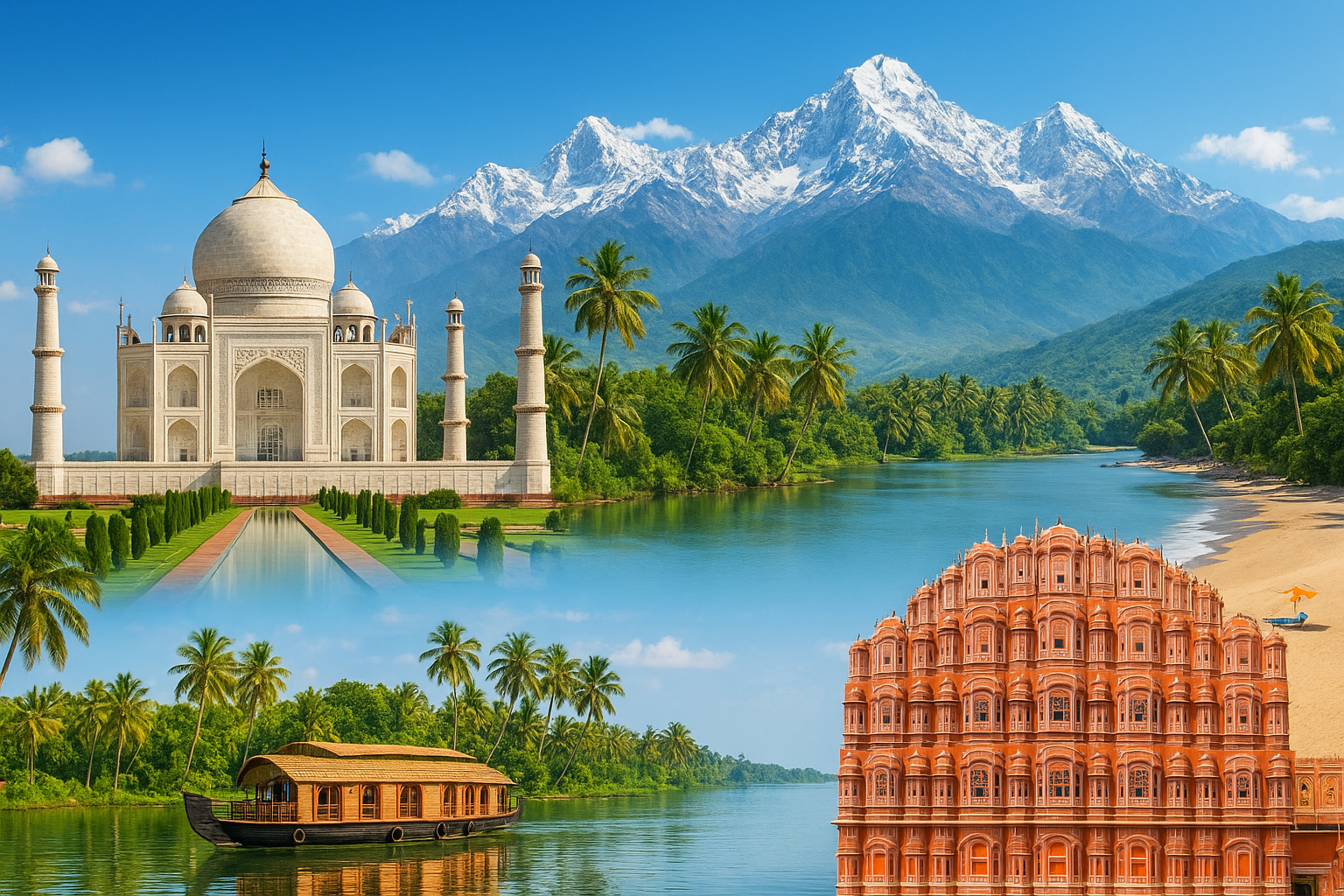
India has one of the world’s oldest and most captivating histories, shaped over thousands of
years by powerful civilizations, royal dynasties, and transformative cultural eras. From the
Indus Valley Civilization and the Vedic period to the emergence of great empires such as the
Mauryas, Guptas, Mughals, and Marathas, India’s past reflects remarkable achievements in
art, philosophy, administration, and learning.
Over time, trade routes, religious movements, and cultural exchanges enriched the land,
leaving behind iconic temples, forts, monuments, and historic cities. The colonial period and
the long struggle for independence played a key role in forming modern India, which gained
freedom in 1947. Today, India’s history continues to thrive through its heritage sites, living
traditions, festivals, and enduring legends, inviting travelers to explore the deep roots of this
diverse nation.
India has a diverse climate due to its vast size, varied geography, and changing seasons. From snow-covered mountains in the north to tropical coastlines in the south, the country experiences multiple climatic patterns throughout the year. Broadly, India’s climate can be understood through four main seasons, along with traditional seasonal classifications followed since ancient times.
1. Winter Season (December to February)
Winter in India lasts from December to February, with January being the coldest month.
Northern India experiences cooler temperatures ranging between 7°C and 15°C, while
southern regions remain relatively mild at around 20°C to 25°C. Snowfall is generally limited
to the Himalayan regions, and most of the country enjoys dry and pleasant weather, making
it an ideal time for travel.
2. Summer Season (March to May)
The summer season begins in March and continues until May. Temperatures rise steadily
from mid-March, with April and May being the hottest months. In many parts of Central and North-West India, temperatures often reach 41°C to 45°C or higher. This season is characterized by dry heat, hot winds, and a strong anticipation of the monsoon rains.
3. Monsoon or Rainy Season (June to September & October to February)
India receives rainfall mainly during the monsoon period, driven by seasonal wind patterns.
● Southwest Monsoon (June to September):
This is the most important monsoon, bringing rainfall to most parts of the country. It
plays a crucial role in agriculture and water supply. The western coastal regions
receive heavy rainfall due to the Western Ghats, making them lush and green.
● Northeast Monsoon (October to February):
This monsoon primarily affects the eastern coast, especially Tamil Nadu and parts of Andhra Pradesh. Rainfall often occurs in the form of cyclones and storms.
4. Spring and Autumn Transitions
A short spring season is noticeable in February and March, particularly in North India, marked by blooming flowers and comfortable temperatures. Autumn follows the monsoon, bringing clear skies and moderate weather.
Northeastern India is unique as it receives rainfall from both monsoons, making it
one of the wettest regions in the world.
Traditional Indian Seasons (Ritus)
Ancient Indian texts divide the year into six seasons (Ritus):
Vasanta
Spring
Greeshma
Summer
Varsha
Rainy Season
Sharat
Autumn
Hemanta
Early Winter
Shishira
Winter